Category: Finance

  • Indian Stock Market Opens Lower: Nifty 50 Drops 0.48%, Sensex Falls 361 Points

    Indian Stock Market Opens Lower: Nifty 50 Drops 0.48%, Sensex Falls 361 Points

    The Indian stock market opened lower amid mixed global trends. The Nifty 50 was down 113.05 points or 0.48% at the open to 23,522.05, while Bank Nifty started 278.7 points below the prior close. Sensex fell 361.36 points to 75,216.22.

    The broader market outperformed, with the Nifty Midcap and Smallcap indices ending marginally higher. The Indian rupee opened marginally lower at Rs. 94.87 per dollar on Wednesday against Tuesday’s close of Rs. 94.82.

    Foreign institutional investors turned net sellers on Tuesday, offloading Rs. 123 crore of Indian equities, while domestic institutional investors bought a net Rs. 1,350 crore, according to NSE data.

    Sensex Outlook

    Technically, the Sensex formed a bearish candle on the daily chart and is holding a lower top formation, which is largely negative.

    “For day traders, 75,800 would act as an immediate resistance zone. Below this, a weak formation is likely to continue. On the downside, the market could retest the levels of 75,200-75,000. On the flip side, if the index closes above 75,800, the pullback could extend till 76,000-76,300,” said Shrikant Chouhan, Head, Equity Research, Kotak Securities.

    Nifty 50 Outlook

    The Nifty 50 formed its second consecutive bearish candle on the daily chart, indicating that the ongoing corrective trend remains intact. The Nifty 50 has now moved close to its July 2026 low of around 23,606, making the current support zone particularly important for traders and investors.

    The index has approached a crucial support area between 23,600 and 23,500. A failure to hold above this range could result in a further decline towards 23,300 in the coming weeks. On the upside, any recovery attempt may face significant resistance around the 24,000-24,050 zone.

    “Pullback attempts from the current oversold territory will face stiff resistance around 24,000-24,050 levels, being the recent breakdown area and 20-day EMA. The support area is likely to reverse its role and act as resistance in the short term,” said Pabitro Mukherjee, Deputy Vice President-Research, Bajaj Broking.

    Bank Nifty Outlook

    Bank Nifty formed a bearish candle with a lower high and lower low, which suggests that the corrective decline in the banking index is continuing. The index closed below the immediate support level of 57,000, which has now become an important level to watch. If Bank Nifty remains below 57,000, the decline could extend towards the 56,500-56,200 range. This zone is considered an important short-term support area as it represents the confluence of the 52-week EMA and the lower band of the index’s nine-week trading range.

    “Immediate bias in the index continues to remain down, and only a formation of higher highs and higher lows on a sustained basis in the daily chart will signal a pause in the downtrend. A move above 57,000 will lead to consolidation in the range of 57,000-58,000,” said Pabitro Mukherjee, Deputy Vice President-Research, Bajaj Broking.

    Disclaimer: Analytics Insight does not provide financial advice or guidance on cryptocurrencies and stocks. This article is provided for informational purposes and does not constitute investment advice. Readers are responsible for conducting their own research before making any investments.

  • FTSE 100 Dips as Oil Prices Surge and Fed Rate Hike Expectations Strengthen

    FTSE 100 Dips as Oil Prices Surge and Fed Rate Hike Expectations Strengthen

    Global stock markets traded mixed on Monday as rising oil prices and growing expectations of a Federal Reserve rate hike shaped investor sentiment. European shares remained subdued, while several Asian markets advanced sharply after strong gains in technology stocks.

    Oil prices stayed near six-week highs as the conflict between the United States and Iran disrupted shipping and crude flows. Meanwhile, strong US employment data raised expectations that the Fed could increase interest rates at its September meeting.

    European Stocks Struggle as Oil Prices Rise

    The pan-European Stoxx 600 slipped almost 0.1% during morning trading. Germany’s DAX fell 0.14%, while France’s CAC 40 and Italy’s FTSE MIB each gained about 0.1%.

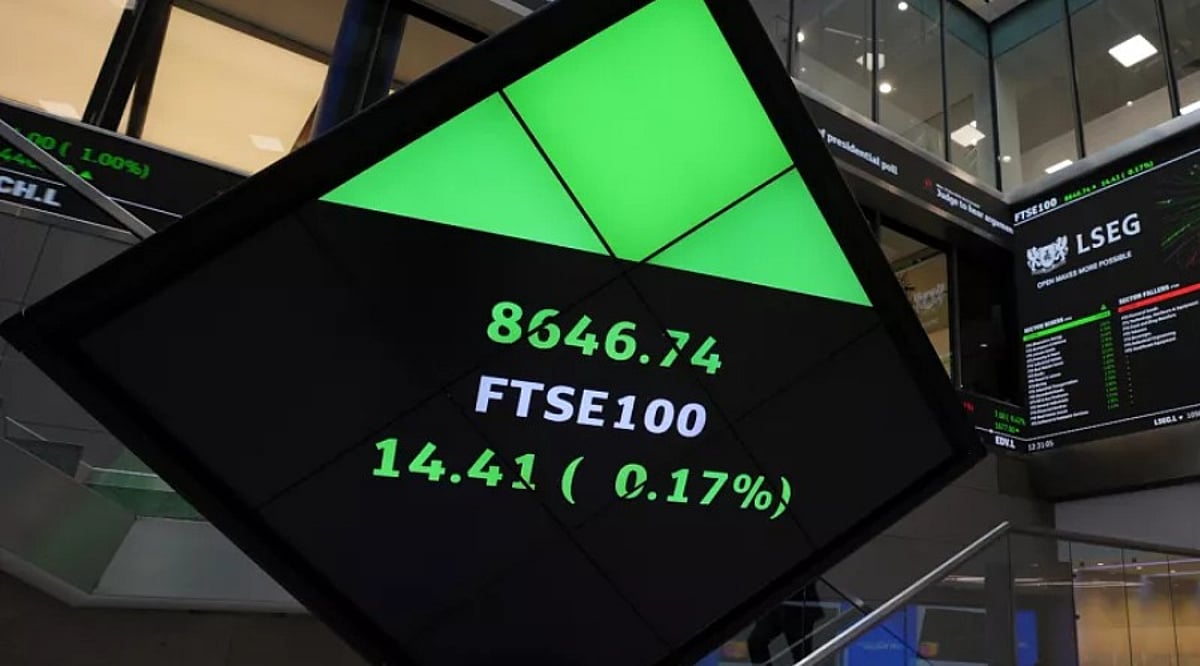
    London’s FTSE 100 fell 0.1% to 10,824.74 points by 0927 GMT, while the FTSE 250 also declined 0.1%. Consumer-focused sectors led losses. Beverage stocks dropped 1.6%, while personal care, drug and grocery shares declined 0.8%.

    Energy shares provided support as higher crude prices lifted oil companies. BP and Shell gained around 1% each. Standard Life rose 1.5% after reporting first-half profit above market expectations, while Ashmore fell 1.4% after annual profit missed forecasts.

    Spire Healthcare gained around 3% after agreeing to a takeover by funds managed by Toscafund, Three Hills and Ares. The deal values its share capital at about EUR 1.03 billion.

    Fed Rate-Hike Bets Rise After Strong US Jobs Report

    Investors increased bets on a September Federal Reserve rate hike after US nonfarm payrolls rose by 162,000 in August. Economists had expected an increase of about 56,000 jobs. The unemployment rate remained at 4.1%.

    Traders now see about a 58% chance of a Fed rate increase at the September 15-16 meeting. Expectations stood near 44% a month earlier. Investors will therefore watch US producer and consumer inflation data later this week for further direction.

    Gold slipped as higher rate expectations reduced demand for non-yielding assets. Spot gold fell 0.2% to about USD 4,421 per ounce.

    Ole Hansen of Saxo Bank said gold had found buying interest below USD 4,400, while resistance remained above USD 4,500. He added that stronger employment data had ‘reinforced expectations of a Fed rate hike on 16 September.’

    Middle East Conflict Keeps Energy Markets in Focus

    Oil prices remained elevated after further US-Iran hostilities affected vessels around the Strait of Hormuz. Iran also said it plans to announce a new restricted zone in the Gulf and provide details of a shipping corridor.

    US Energy Secretary Chris Wright also raised doubts over the chances of a near-term nuclear agreement with Iran. “There may not be a nuclear agreement,” Wright said, adding that an agreement ‘may await the next administration in Iran.’

    Higher energy costs have added pressure to inflation expectations across major economies. Markets are now tracking whether rising fuel prices could affect future central bank decisions.

    Asian Markets Rise While Wall Street Remains Closed

    Asian markets mostly advanced on Monday. South Korea’s Kospi jumped 4.61%, while Japan’s Nikkei 225 gained 2.12%. Samsung rose 5.68%, SK Hynix climbed 8.26%, and SoftBank advanced 11.22%.

    Mainland China’s CSI 300 gained 0.59%, while Australia’s S&P/ASX 200 edged 0.06% higher. Hong Kong’s Hang Seng moved in the opposite direction and fell around 0.9%.

    US stock exchanges remained closed Monday for Labor Day. Regular trading will resume on Tuesday, September 8. Investors will return to markets with oil prices, Treasury yields, inflation data, and the September Fed decision in focus.

    Disclaimer: This article is provided for informational purposes and does not constitute investment advice. You are responsible for conducting your own research before making any investments.

  • 7 Innovations Reshaping Cross-Border Payments for a Faster, Smarter Future

    7 Innovations Reshaping Cross-Border Payments for a Faster, Smarter Future

    Blockchain Technology

    Blockchain enables payment networks to record transactions on shared digital ledgers, reducing the need for multiple intermediaries. This technology can enhance transparency, lower processing costs, and accelerate international transfers. Financial institutions and fintech companies are increasingly adopting blockchain-based systems to build more efficient cross-border payment infrastructure.

    Artificial Intelligence

    Artificial intelligence helps payment providers detect fraud, assess transaction risks, and automate compliance checks across international transfers. AI systems quickly analyze large volumes of payment data, identify unusual activity, and minimize manual intervention. This makes cross-border transactions safer while improving operational efficiency.

    Central Bank Digital Currencies

    Central bank digital currencies (CBDCs) could reshape international payments by enabling digital settlement through central-bank-backed money. Cross-border CBDC projects are exploring faster transactions, lower costs, and improved transparency. Interoperability between different national digital currencies may eventually make international transfers more seamless for businesses and consumers.

    Real-Time Payment Networks

    Real-time payment networks allow funds to move between countries much faster than traditional banking systems. International connectivity between domestic instant-payment platforms reduces settlement delays and improves cash flow. These networks are becoming increasingly vital as consumers and businesses demand faster, simpler, and more transparent international transactions.

    Stablecoins

    Stablecoins combine blockchain-based transfers with digital assets designed to maintain relatively stable values against traditional currencies. They enable faster international settlements and operate beyond conventional banking hours. Financial institutions and payment companies are examining stablecoins as tools to reduce costs and improve cross-border payment accessibility.

    Embedded Payments

    Embedded payment technology integrates international payment capabilities directly into digital platforms, marketplaces, business software, and financial applications. This approach removes several steps from traditional payment journeys, creating smoother user experiences. Businesses can manage international collections, payouts, and transactions without requiring customers to navigate separate banking platforms.

    Open Banking and APIs

    Open banking APIs allow financial institutions, fintech companies, and payment providers to connect systems and exchange payment information securely. These connections simplify international transfers, improve account verification, and support automated payment services. Greater interoperability could help build faster and more competitive cross-border payment ecosystems.

  • Indian Stock Market Opens Lower: Nifty 50 Falls 0.15%, Sensex Drops 161 Points

    Indian Stock Market Opens Lower: Nifty 50 Falls 0.15%, Sensex Drops 161 Points

    The Indian stock market opened lower on Tuesday amid mixed global cues. The Nifty 50 slipped 36.05 points (0.15%) to 23,743.10, while the Bank Nifty started 97.9 points below the prior close. The Sensex fell 161.18 points to 75,970.28.

    The broader market was mixed: the Nifty Midcap index dropped 0.5%, while the Smallcap index remained flat. The Indian rupee opened unchanged at Rs. 94.51 against the US dollar compared to the previous close of Rs. 94.49.

    Foreign institutional investors (FIIs) bought equities worth Rs. 280 crore on September 7, while domestic institutional investors (DIIs) were net buyers, purchasing Rs. 566 crore worth of equities.

    Sensex Outlook

    Technically, the Sensex formed a bearish candle on the daily chart, indicating persistent selling pressure and weakness.

    “76,300 would act as a key resistance zone. Below this, a correction wave is likely to continue. On the downside, the market could slip to 76,000-75,600. On the flip side, above 76,300, a pullback could continue till 76,500-76,700,” said Shrikant Chouhan, Head of Equity Research at Kotak Securities.

    Nifty 50 Outlook

    The Nifty 50 continues to show weakness. The index formed a bearish candle on the daily chart, and the close below 23,800 points to a continuation of the ongoing corrective phase.

    The immediate trend remains negative as long as the index trades below 24,025. Sustained weakness below this level could drag the Nifty towards the 23,600-23,500 support zone. On the upside, 24,150 is expected to act as a key resistance level. The zone gains importance as it coincides with last week’s high and the 50-day EMA.

    “Key observation in the daily chart is that the daily stochastic and daily 14-period RSI has approached oversold territory. Hence, the index holding above the support area of 23,600-23,500 will lead to a pullback towards the 50-day EMA placed around 24,150,” said Pabitro Mukherjee, Deputy Vice President-Research, Bajaj Broking.

    Bank Nifty Outlook

    Bank Nifty formed a bearish candle on the daily chart, with a lower high and a lower low. Bajaj Broking Research expects the index to remain within its broader consolidation range unless a decisive breakout or breakdown occurs.

    In the near term, Bank Nifty is expected to trade between 57,000 and 58,000. A close below 57,000 could strengthen selling pressure and take the index towards the 56,500-56,200 support zone.

    “Within the consolidation, the index is facing resistance around 58,000 levels. Sustaining above 58,000 will open the way towards 58,500-58,700 levels. Failure to sustain above 58,000 will signal an extension of range-bound trade in the 57,000-58,000 zone in the coming sessions,” added Pabitro Mukherjee.

    Disclaimer: Analytics Insight does not provide financial advice or guidance on cryptocurrencies and stocks. This article is for informational purposes only and does not constitute investment advice. Always conduct your own research before making any investment decisions.

  • MCX Gold Rises 0.77% to Rs 1,53,992 on Spot Demand, Brent Crude at $97.57

    MCX Gold Rises 0.77% to Rs 1,53,992 on Spot Demand, Brent Crude at $97.57

    Gold prices advanced on the Multi Commodity Exchange (MCX) on September 8, driven by robust spot market demand and supportive global cues. The October gold futures contract climbed 0.77% to Rs 1,53,992 per 10 grams, while silver futures for September slipped 0.96% to Rs 2,41,304 per kilogram.

    In the international oil market, Brent crude futures rose 0.59% to USD 97.57 per barrel, and US West Texas Intermediate (WTI) gained 1.64% to USD 92.98 per barrel.

    Market participants are closely watching the Federal Reserve’s next move. According to the CME FedWatch Tool, there is a 41.6% probability that the Fed will keep interest rates unchanged in September, while a 58.4% chance points to a rate hike.

    Domestic Gold Prices

    In the Indian bullion market, 24K gold rose by Rs 120 to Rs 1,55,350 per 10 grams, and 22K gold advanced by Rs 110 to Rs 1,42,400. Regional prices varied slightly: Mumbai and Kolkata quoted Rs 1,55,350, Delhi at Rs 1,55,500, and Chennai at Rs 1,55,670.

    US Gold Prices

    Gold prices in the US climbed on Tuesday as the US dollar weakened. Investors are now focused on upcoming inflation data, which could influence the Federal Reserve’s policy direction. Spot gold rose 0.6% to USD 4,429.89 per ounce, while US gold futures for December delivery traded at USD 4,475.10.

    Other precious metals also gained: spot silver added 1% to USD 66.78 per ounce, platinum rose 0.4% to USD 1,834.00, and palladium firmed 1% to USD 1,402.87.

    Key Levels to Watch

    Chris Weston, head of research at Pepperstone Group, noted that gold remains in a tug-of-war between buyers and sellers, with neither side showing enough conviction for a sustained directional move. Edward Meir of Marex added in a monthly note that gold is unlikely to fall sharply even if the central bank raises rates, emphasizing that market unease about Fed and Treasury signals matters more than the rate move itself.

    On MCX, gold faces support at Rs 1,51,750 and Rs 1,50,500, with resistance at Rs 1,53,850 and Rs 1,54,700. Silver has support at Rs 2,36,600 and Rs 2,35,000, and resistance at Rs 2,41,000 and Rs 2,44,000.

  • FTSE 100 Opens Lower as Oil Nears $100; Computacenter Profit Forecast Lifts Sentiment

    FTSE 100 Opens Lower as Oil Nears $100; Computacenter Profit Forecast Lifts Sentiment

    The FTSE 100 opened 16.06 points lower at 10,806.07 on Tuesday as investors awaited fresh direction from the European Central Bank’s interest rate decision and upcoming US inflation figures. Brent crude futures rose 1.75% to $98.70 per barrel, while US West Texas Intermediate (WTI) advanced 2.89% to $94.12 per barrel.

    Sterling traded at $1.3538 on Tuesday morning, up from $1.3516 at the London equities close on Monday. Against the euro, it slipped to €1.1624 from €1.1638.

    Gainers and Losers

    On the upside, Computacenter climbed 4.64% to 5,860p after upgrading its profit forecast for the second time this year. Auto Trader Group advanced 3.60% to 523.60p, while Antofagasta gained 1.51% to 3,957p. Croda International rose 1.50% to 3,312p, BP added 1.43% to 554.20p, and Glencore increased 1.42% to 612.40p.

    On the downside, HSBC Holdings fell 1.43% to 1,556.40p. Next declined 1.16% to 15,320p, while Whitbread dropped 1.02% to 2,324p. Games Workshop Group slipped 0.71% to 18,270p, Lion Finance Group lost 0.67% to 13,420p, and AstraZeneca edged 0.60% lower to 11,970p.

    Oil Nears $100 Per Barrel

    Oil prices have surged, nearing the $100 per barrel mark. Brent crude gained 1.75% to reach its highest level since July. Reports that Iran-backed Houthis attacked a Saudi energy plant have added fresh pressure on investors. Earlier today, Iran threatened new sanctions on tankers attempting to travel through the Strait of Hormuz.

    Computacenter Increases Profit Forecast

    Computacenter upgraded its profit forecast for the second time this year after its order backlog quadrupled in the last six months. The IT supplier expects to bring in no less than £380 million in pretax profit for the year, well above the previous consensus of £341 million. The order backlog reached a record £9.3 billion, up 323% year-on-year. The group, promoted to the FTSE 100 in the June reshuffle, hiked its dividend by nearly 15% to 27.1p.

    Funding Circle Lifts Profit Forecast

    The boss of Funding Circle has laid out plans for departure as the fintech lifted its profit forecast for the year ahead. Lisa Jacobs, who has led the firm since 2022, will step down as chief executive by no later than September 2027. Revenue jumped 50% to £138 million after loan originations swelled 43% to just over £1 billion. The firm expects profit to reach over £40 million for the year, upgraded from previous expectations of £35 million. Funding Circle also announced a fresh £25 million buyback, bringing total capital returned via buybacks to £100 million since March 2024.

    Global Market View

    In the US, Wall Street was closed on Monday for the Labor Day holiday. In Asia on Tuesday, Tokyo’s Nikkei 225 fell 1.7% to 65,269.33, while China’s Shanghai Composite rose 0.2%. Hong Kong’s Hang Seng declined 0.32%, and South Korea’s Kospi declined 0.58%. In India, both the Nifty 50 and the Sensex fell by 0.54% and 0.59%, respectively.

    Disclaimer: This article is for informational purposes only and does not constitute investment advice. Cryptocurrencies and stocks involve risk. Always conduct your own research before investing.

  • Selecting Tech Stocks for Long-Term Growth: A Data-Driven Framework

    Selecting Tech Stocks for Long-Term Growth: A Data-Driven Framework

    In the current market, a strong technology company can still be a weak stock pick if the price is wrong. With artificial intelligence (AI) reshaping profit outlooks, capital expenditures, and market expectations, the selection process demands more than just a famous brand or a good product. A truly long-term stock needs a clear path to higher sales, improved profits, and robust cash flow, all while the share price leaves room for future returns.

    Prioritize Real Growth Over Hype

    The first test is the quality of growth. Companies with steady, consistent sales growth are stronger than those dependent on a single demand spike. While revenue is important, profit growth provides a clearer signal of business health. Equally critical is free cash flow (FCF), which shows how much cash remains after operating expenses and capital investments. For instance, State Street notes that major hyperscalers raised their 2026 capital expenditure estimates by 15% from March to $772 billion, and semiconductor earnings are expected to rise 86% in 2026. However, these figures indicate a powerful AI cycle, not that every chip stock is a sound long-term buy. The real question is whether demand can convert into durable profit.

    Identify a Sustainable Moat

    A tech company needs a lasting competitive advantage that rivals cannot easily replicate. This moat can stem from a strong software ecosystem, high customer switching costs, proprietary chip design, a vast cloud network, or a trusted brand. With AI, a new dimension emerges: companies must demonstrate that their technology solves real customer problems and delivers measurable value. As Charles Schwab points out, investors now look for proof that large AI budgets lead to revenue growth, user adoption, or other tangible returns. Cloud growth and margins also indicate whether AI demand can support profit alongside sales.

    Examine Cash Flow Before the Narrative

    Large tech firms now face enormous capital requirements for data centers, chips, and networks. Charles Schwab reports that the Magnificent Seven could spend over $700 billion on capital expenditure in 2026, having already sold more than $130 billion in debt this year, while their free cash flow has fallen sharply from its 2024 peak. Investors must scrutinize whether a company’s spending is efficient and whether its cash generation can sustain such investments without overleveraging.

    Valuation Is a Core Criterion

    Valuation cannot be ignored. Fidelity’s August 2026 tech screen used cash flow growth and long-term earnings growth, while its valuation screen applied forward price-to-earnings (P/E), price-to-cash-flow, and price-to-earnings-growth (PEG) ratios. NVIDIA, Microsoft, TSMC, and Broadcom appeared in the valuation screen, while NVIDIA, TSMC, Broadcom, Micron, and AMD showed up in growth results. A high-quality company can still underperform if its stock price already factors in unrealistic future growth.

    Analyze the Entire AI Supply Chain

    The AI boom extends beyond GPUs to chips, memory, networking, cloud systems, and data center equipment. As workloads become more complex, demand spreads across a wider technology stack. However, this breadth introduces cyclical risks. Semiconductor and memory stocks face sharp cycles and supply shifts, while software companies must show their AI products boost revenue, adoption, and subscriptions. Each segment carries distinct competitive and cyclical risks that require separate evaluation.

    Focus on Durable Returns and Management

    A long-term tech stock needs a business model that supports multi-year growth in sales, margins, and cash flow. Management quality is paramount: a capable team uses capital wisely, maintains a healthy balance sheet, and offers clear guidance. Market concentration adds another concern—Charles Schwab notes that a handful of tech companies now drive more than half of global market earnings growth, heightening concentration risk.

    The best tech stock is not always the fastest grower or the one with the flashiest AI product. The stronger choice combines a durable moat, genuine cash generation, manageable debt, solid earnings prospects, and a share price that doesn’t demand perfection. This standard separates a business with a great future from a stock that has already priced in too much of it.

    Frequently Asked Questions

    1. What should investors look for in a long-term tech stock?
    Investors should assess revenue and earnings growth, free cash flow, competitive advantages, debt levels, capital spending, and valuation.

    2. Is strong AI exposure enough to make a tech stock attractive?
    No. AI exposure can support growth, but investors must determine if that growth translates into sustainable profits and cash flow.

    3. Why is free cash flow important for tech companies?
    Free cash flow shows how much cash a company generates after operating needs and capital investments, helping investors gauge financial strength.

    4. How does valuation affect long-term tech stock returns?
    A high-quality company can still be a poor investment if its stock price assumes extremely high growth, leaving little room for future upside.

    5. Should investors consider the entire AI supply chain?
    Yes. AI growth affects semiconductors, memory, networking, cloud infrastructure, and data centers, but each segment carries different competitive and cyclical risks.

  • How Modern Technology Is Making Payments Faster and More Secure

    How Modern Technology Is Making Payments Faster and More Secure

    Technology is transforming the way we pay, making transactions both faster and safer. From real-time settlement to biometric verification, here are the key innovations driving this change.

    Real-Time Payments

    Real-time payment systems enable money to move between accounts within seconds. Services like UPI have made instant transactions practical for everyday purchases, bills, and transfers. This reduces waiting periods and provides immediate confirmation. Businesses benefit from quicker settlements, improved cash flow, and smoother customer payment experiences.

    Biometric Authentication

    Biometric authentication adds an extra security layer by using fingerprints, facial recognition, or other unique characteristics. Instead of relying solely on passwords or PINs, payment systems can verify the person making a transaction. This deters unauthorized access while allowing users to complete transactions quickly without repeatedly entering lengthy credentials.

    Tokenization

    Tokenization replaces sensitive card information with unique digital tokens during transactions. Merchants and payment platforms process payments without directly exposing the actual card number. Even if transaction data is intercepted, the token generally cannot be used like the original card details, reducing risks associated with stolen payment information.

    Artificial Intelligence

    Artificial intelligence helps payment companies identify unusual transaction patterns and potential fraud. Systems analyze transaction behavior, location, device information, and other signals to detect suspicious activity quickly. This allows financial institutions to flag or block potentially fraudulent payments while minimizing unnecessary interruptions for legitimate transactions.

    Contactless Payments

    Contactless payments use technologies like near-field communication (NFC) so users can pay by tapping compatible cards, phones, or wearables. Transactions complete within seconds without inserting a card or re-entering details. Secure authentication and transaction limits provide additional protection, making contactless payments convenient for everyday use.

    Encryption and Security

    Encryption protects payment information as it moves between devices, banks, and payment networks. Modern payment platforms also use secure authentication, fraud monitoring, and layered security controls. These measures help safeguard sensitive financial data from unauthorized access while allowing legitimate transactions to flow efficiently between customers, merchants, and financial institutions.

    Digital Wallets

    Digital wallets bring payment cards, bank accounts, and other payment options together in one application. Users can transact through smartphones or wearable devices without carrying physical cards. Wallets often incorporate device authentication, tokenization, and transaction monitoring, combining convenience with multiple security measures for everyday digital payments.

  • PVR INOX Shares Tumble 8% Following Buyback Record Date and Internal Investigation Report

    PVR INOX Shares Tumble 8% Following Buyback Record Date and Internal Investigation Report

    PVR INOX shares fell more than 8% on Monday, September 7, as investors reacted to the passing of the record date for the company’s Rs. 300 crore share buyback and a media report about an internal investigation involving a former senior executive.

    The stock dropped as much as 8.27% to Rs. 1,125.70 on the NSE during early trade before recovering 4%. PVR INOX had fixed September 4 as the record date for determining shareholders eligible to participate in the buyback.

    PVR INOX Buyback Record Date Passes

    PVR INOX plans to repurchase up to 20.69 lakh equity shares at Rs. 1,450 per share through the tender-offer route. The total buyback size is up to Rs. 300 crore. The announcement had earlier supported buying interest in the stock as investors positioned themselves ahead of the record date. However, with September 4 now behind, investors who bought shares mainly to become eligible for the offer no longer need to hold the stock. This may have contributed to selling pressure on Monday.

    The Rs. 1,450 buyback price does not guarantee that every eligible shareholder can sell all their shares at that price. The company will accept only the specified number of shares under the offer.

    Meanwhile, JM Financial retained its ‘ADD’ rating on PVR INOX and raised its 12-month target price to Rs. 1,270 from Rs. 1,130. The brokerage also increased its valuation multiple to 9 times EV/EBITDA from 8 times.

    Report on Internal Investigation Adds Pressure

    The decline also came after a media report said PVR INOX had conducted an internal investigation into alleged kickbacks involving a former senior executive. The Economic Times reported that the company asked Pramod Arora, its former CEO for growth and investment, to leave in April after an internal probe. The report said alleged payments from developers involved in cinema property construction may have reached as much as Rs. 200 crore over several years.

    PVR INOX has not publicly confirmed or denied the reported Rs. 200 crore amount. The figure therefore remains based on the media report and has not been independently established through a company disclosure.

    Nuvama Institutional Equities, meanwhile, maintained its ‘BUY’ rating and raised its target price to Rs. 1,640 from Rs. 1,620. The brokerage expects the company to benefit from its film release pipeline during FY27.

    PVR INOX Q1 FY27 Profit Returns, Revenue Rises

    PVR INOX reported a consolidated profit after tax attributable to owners of Rs. 56.5 crore for the June quarter of FY27. The company had posted a net loss of Rs. 54.5 crore in the same quarter a year earlier. Revenue from operations rose 11.91% year-on-year to Rs. 1,622.20 crore from Rs. 1,449.6 crore. EBITDA increased 30.91% to Rs. 529 crore from Rs. 404 crore, while the EBITDA margin rose to 32.58% from 27.85%.

    The multiplex operator is also expanding into smaller cities. On September 4, the company announced its first SMART Cinema at ICON Plaza Mall in Muzaffarpur, Bihar. PVR INOX said, “The opening marks the first step in PVR INOX’s strategy to expand its presence across India’s emerging growth markets.” The four-screen property has 644 seats. Following the launch, PVR INOX operates about 1,785 screens across 356 properties in 114 cities in India and Sri Lanka. The company was formed through the merger of PVR Limited and INOX Leisure Limited in 2023.

  • India’s NIIF Taps Ex-PAG Executive Gauravjit Singh to Lead Global Fundraising

    India’s NIIF Taps Ex-PAG Executive Gauravjit Singh to Lead Global Fundraising

    India’s National Investment and Infrastructure Fund Limited (NIIF) has appointed Gauravjit Singh, a former executive at private markets firm PAG, as Managing Partner and Global Head of Capital Formation. The move underscores NIIF’s push to expand its investor base for infrastructure, private markets, and climate-related investments.

    Gauravjit Singh to Drive NIIF’s Capital Strategy

    Singh brings nearly two decades of experience in institutional fundraising across global, India-focused, and pan-Asian investment strategies. He most recently served as Head of Investor Relations and Fundraising for PAG’s private equity business in Singapore, where he also sat on PAG’s Investment and Exit Committees. Prior to PAG, Singh held roles at True North and KKR. At True North, he led investor relations and supported the firm’s expansion into private credit and new institutional markets across the United States, Europe, the Middle East, North Africa, and Japan.

    Strengthening Investor Ties and Mobilizing Capital

    NIIF said Singh will focus on deepening existing investor relationships while identifying new sources of capital. The appointment follows a period of increased fundraising activity: the sovereign-anchored asset manager has raised approximately $3 billion in new equity commitments over the past 24 months across its strategies covering infrastructure, private markets, growth equity, and climate-related investments.

    Sanjiv Aggarwal, Managing Director and CEO of NIIF, emphasized the importance of expanding the investor network. “Deepening our relationships with existing investors, bringing new investors into the NIIF ecosystem and broadening our sources of capital will be important priorities,” Aggarwal said.

    Recent Fund Closings Highlight Momentum

    NIIF has closed several large funds in 2026. Its Private Markets Fund II secured commitments of up to $750 million at its first close earlier this year, targeting a total of $1 billion. In August, NIIF announced a ₹19,000 crore (about $2 billion) first close for Infrastructure Fund II, exceeding 60% of its ₹30,000 crore (roughly $3.2 billion) target. The fund received backing from the Government of India, sovereign wealth funds, pension funds, insurance companies, and Indian financial institutions.

    Singh commented on India’s appeal to global investors: “India has become an important market for global institutional investors seeking long-term investment opportunities. NIIF’s role is to create meaningful and investable pathways to accelerate the flow of capital into India’s growth.” He added that he plans to build on relationships with existing investors while bringing new institutional partners to the platform.