
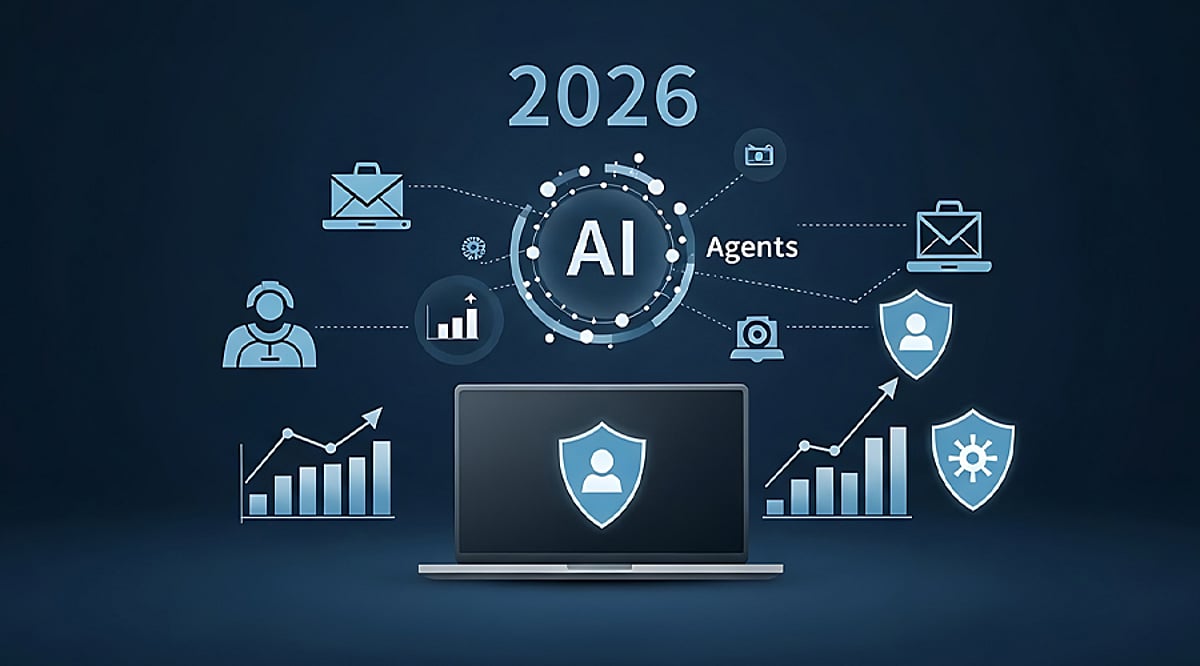
Artificial intelligence is moving beyond chatbots and into the core of business operations. In 2026, companies are leveraging AI not just for automation but for autonomous workflows, specialized models, and measurable returns. Here are the seven key trends reshaping business technology this year.
1. Agentic AI Moves Into Business Workflows
AI agents are evolving from simple chatbots to autonomous systems that plan tasks, use business tools, and complete multi-step processes. Organizations are testing multiagent setups where different agents handle research, analysis, approvals, and execution—all under human oversight.
2. Smaller AI Models Drive Enterprise Efficiency
Enterprises are shifting away from relying solely on the largest AI models. Smaller, domain-specific models excel at document processing, customer support, internal search, and invoice extraction. These models reduce costs and latency while giving companies greater control over sensitive data.
3. AI Infrastructure Becomes a Business Priority
The growing demand for AI workloads is pushing companies to invest in robust infrastructure. Combining GPUs, CPUs, specialized chips, cloud systems, and edge computing helps manage latency, privacy, and large data volumes. Local and hybrid setups are gaining traction.
4. AI Strengthens Cybersecurity and Governance
As AI becomes more autonomous, businesses need stronger controls around access, data, and model behavior. AI can detect unusual activity and speed up threat response, while governance systems track agents, permissions, risks, and compliance. Security is now an integral part of AI development.
5. Physical AI Brings Intelligence to the Real World
AI is moving from screens into factories, warehouses, and logistics. Intelligent robots support quality inspection, predictive maintenance, warehouse operations, and manufacturing. This trend bridges AI software with real-world automation.
6. Multimodal and Voice AI Enter Core Operations
AI systems now handle text, images, audio, video, and documents in a single workflow. Businesses use these capabilities for call centers, document processing, field services, compliance, and regional-language support. Voice AI is also becoming more practical for customer and employee interactions.
7. Measurable ROI Defines the Next Phase of AI
Companies are moving from AI experiments to measurable outcomes. They track metrics like cost reduction, faster workflows, productivity gains, revenue impact, and customer experience. In 2026, the focus is on building reliable systems that deliver value at scale.
These trends highlight a shift from experimentation to strategic integration, where AI is embedded into every layer of business technology.
Leave a Reply