
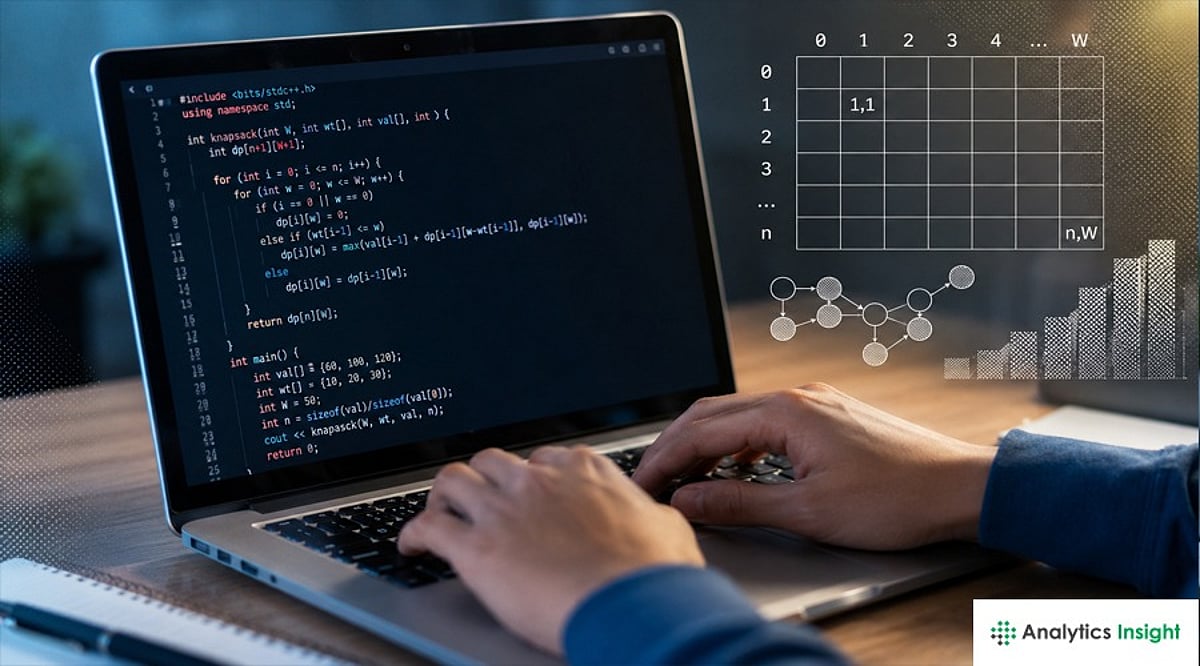
Dynamic programming remains one of the most important coding interview topics in 2026. Mastering common DP patterns, understanding company-specific expectations, and practicing representative problems can significantly improve problem-solving skills and increase success in technical interviews at top technology companies.
Why Pattern Recognition Beats Memorization
Interview data from recent hiring cycles suggests that around 87% of coding questions at Google, Meta, Apple, Netflix, and Amazon are built around just 10 to 12 core problem-solving patterns, with dynamic programming forming one of the most versatile among them. The core idea behind DP is simple even when the problems aren’t: break a larger problem into smaller, overlapping subproblems, solve each one exactly once, and store the results, typically through memoization or a tabulation array, so the same subproblem is never recomputed. Any time a question asks for a maximum, minimum, or count of ways to do something under constraints, there’s a strong chance dynamic programming applies.
The Core Patterns Worth Mastering
DP breaks down into a manageable number of recognizable categories rather than one giant, undifferentiated topic. Knapsack-style problems (0/1 and unbounded variants) cover resource allocation and optimization questions. Grid-based 2D DP tests a candidate’s ability to reason across two-dimensional state spaces with multiple transition directions. String DP handles text-processing challenges like edit distance and longest common subsequence, patterns with direct application in areas like version control and bioinformatics. Interval DP applies to scheduling and matrix chain multiplication-style problems, while state-machine DP models transitions governed by specific rules, useful in problems involving buy/sell timing or step-based decisions.
Frequently Asked DP Problems in 2026
Company-Specific Differences Worth Knowing: Every organization does not follow the same approach toward DP problems. The first difference between companies is that Google requires higher DP expertise compared to other organizations, not only in 1D problems such as staircase problems but 2D Grid, String DP and even DP on Trees/Graphs problems and an overall preference for harder problems in general. The next two organizations, Meta and Amazon, have more focus on array and string DP problems with medium-level difficulty. Microsoft avoids going into hard problems related to DP and prefers medium-level difficult problems along with good explanations. This shows that preparation according to the requirements of a particular company pays off in a bigger way.
How to Actually Prepare for DP Interviews
The most optimal form of preparation is no different from the tried and tested methods of pattern-based preparation. The method is to select a canonical example for each pattern, practice solving it until the logic of the solution takes under two minutes to describe and then use that logic for other variations. Interviewers are much more concerned about the ability of candidates to recognize the structure of subproblems, verbally derive a recurrence relation for the same and explain their trade-offs on time and space than knowing whether the candidate has seen the problem or not. Considering the frequent appearance of DP questions on arrays, strings, trees and grids, spending the effort to really comprehend a few basic patterns goes a long way.
Why This Matters
Dynamic programming is one of the most frequently tested problem-solving techniques in software engineering interviews. Understanding its recurring patterns helps candidates solve complex coding challenges efficiently, improve algorithmic thinking, and perform better in technical interviews across leading technology companies.
FAQs
What is dynamic programming in programming?
Dynamic programming (DP) is an algorithmic technique used to solve complex problems by breaking them into smaller overlapping subproblems. Instead of solving the same subproblem repeatedly, DP stores previously computed results using memoization or tabulation, significantly improving time efficiency.
Why is dynamic programming important for coding interviews?
Dynamic programming tests a candidate’s problem-solving ability, optimization skills, and understanding of algorithms. Many leading technology companies include DP questions because they evaluate logical thinking, recurrence formulation, state transitions, and the ability to optimize brute-force solutions into efficient algorithms.
Which companies frequently ask dynamic programming questions?
Dynamic programming questions commonly appear in interviews at Google, Meta, Amazon, Microsoft, Apple, Netflix, Adobe, Uber, and many other technology companies. Google generally asks more advanced DP problems, while Amazon and Meta often focus on medium-difficulty array and string-based DP questions.
What are the most common dynamic programming patterns?
The most frequently tested DP patterns include 0/1 Knapsack, Unbounded Knapsack, Grid DP, String DP, Interval DP, State Machine DP, Tree DP, and Bitmask DP. Learning these core patterns enables candidates to solve a wide variety of interview problems efficiently.
How should beginners start learning dynamic programming?
Beginners should first understand recursion before learning memoization and tabulation. They should then practice simple problems like Fibonacci, Climbing Stairs, and House Robber before progressing to Knapsack, Longest Common Subsequence, Coin Change, and more advanced DP patterns.
Leave a Reply