
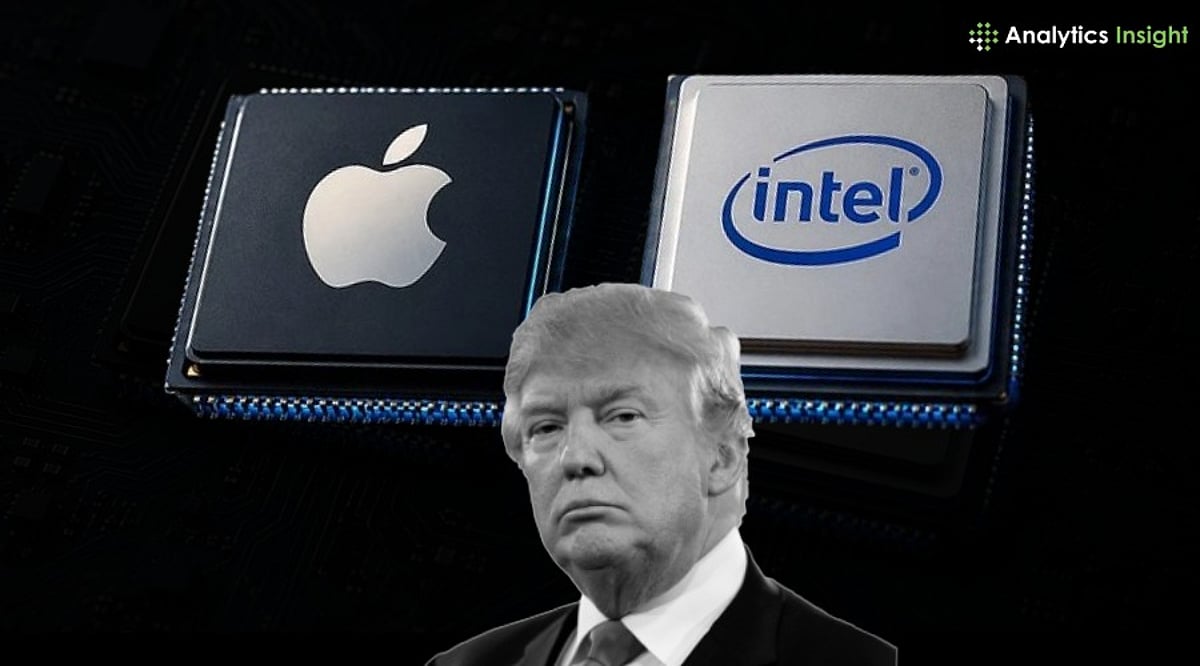
The Trump administration has taken an active role in Intel’s recovery, urging major US technology companies to invest in or work with the chipmaker. Apple, NVIDIA, and SpaceX have entered talks or partnerships with Intel as Washington seeks to expand semiconductor production within the United States.
This support has improved Intel’s access to capital and raised demand for its processors. However, the company’s contract manufacturing business still relies heavily on work from Intel’s own product units. Outside foundry revenue remains small compared with the wider manufacturing division.
White House Presses Tech Firms to Back Intel
President Donald Trump and Commerce Secretary Howard Lutnick urged Apple Chief Executive Tim Cook to use Intel’s US factories during talks over proposed semiconductor tariffs. Apple later reached a preliminary agreement for Intel to manufacture selected chips, though large-scale production may take several years.
Washington also converted about $8.87 billion in federal funding into an equity position of roughly 10% in Intel, making the US government the company’s largest shareholder. NVIDIA subsequently invested $5 billion, while SoftBank added $2 billion. Officials also encouraged Intel to work with NVIDIA and SpaceX.
Meanwhile, Intel Chief Executive Lip-Bu Tan reorganized engineering teams and shifted spending toward equipment for advanced production and packaging. Intel also recruited managers with experience at Samsung Electronics and SK Hynix.
Server Sales Rise as Intel Posts a Loss
Intel reported first-quarter revenue of $13.6 billion, up 7% from one year earlier. Data Center and AI revenue rose 22% to $5.1 billion as cloud and AI customers bought more Xeon processors. Intel still recorded a net loss of $3.7 billion, partly linked to restructuring charges.
The company expects second-quarter revenue between $13.8 billion and $14.8 billion and projects adjusted earnings of $0.20 per share. Tan said AI inference is ‘significantly increasing the need for Intel’s CPUs and wafer and advanced packaging offerings.’
Additionally, Intel expanded its work with Google Cloud. The companies agreed to use Intel Xeon processors across AI, inference, and general computing tasks. The agreement gives Intel a large processor customer, though it does not establish Google as a major outside buyer for Intel’s foundry plants.
Outside Foundry Revenue Stays Limited
Intel Foundry reported $5.4 billion in first-quarter revenue, up 16% from a year earlier. Most of that amount came from Intel’s internal product groups. External foundry revenue reached only $174 million, compared with $31 million in the same quarter of 2025.
The increase mainly came after Altera became an outside customer following its separation from Intel. Intel’s filing said the change accounted for much of the $143 million annual rise. Chief Financial Officer David Zinsner described the outside sales as ‘legacy business that we have mainly on the wafer side.’
Intel has identified external foundry growth as a key long-term strategy. The company has secured capital, processor agreements, and government support, but first-quarter figures show that third-party manufacturing orders have not yet become a major source of revenue.
Leave a Reply