
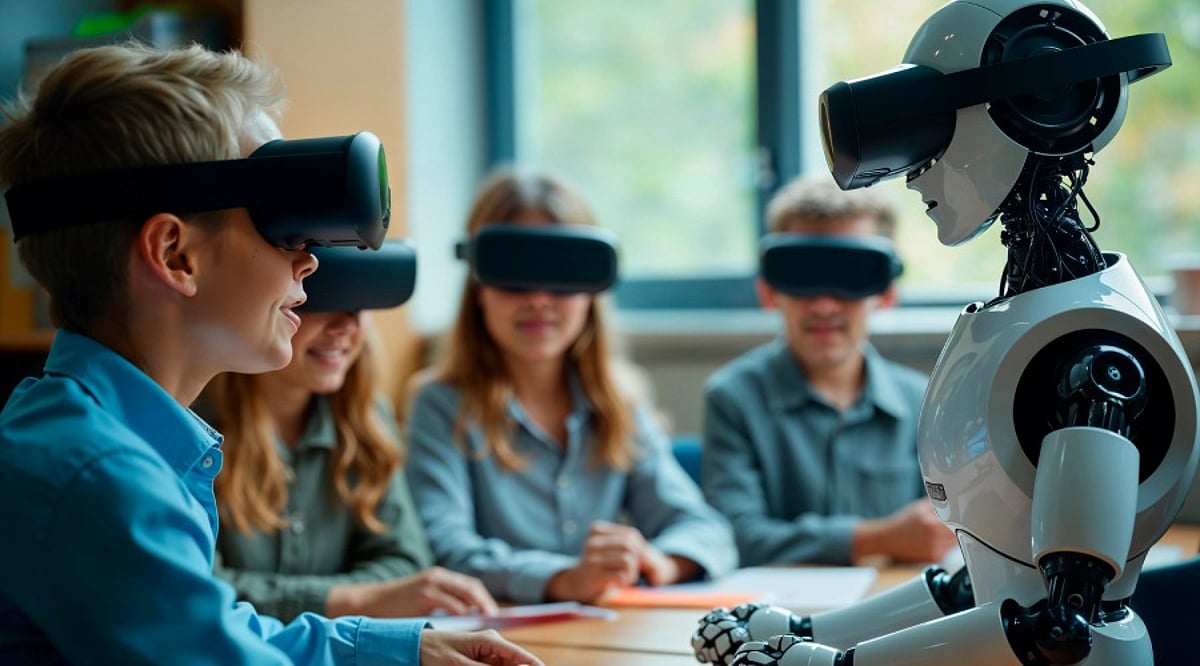
Artificial intelligence is reshaping the educational landscape, influencing how students learn, how teachers work, and how institutions manage their operations. From personalized learning platforms to automated grading and virtual tutors, AI is making education more adaptive, accessible, and data-driven.
The Shift in Skills Demand
This transformation aligns with changing workforce needs. According to the World Economic Forum’s Future of Jobs Report 2025, 39% of core skills required by workers will change over the next decade, with AI and big data among the fastest-growing skill areas. This underscores the urgent need for schools, universities, and training providers to redesign curricula around digital literacy and lifelong learning.
Personalized Learning at Scale
Traditional classrooms follow a one-size-fits-all curriculum. AI-powered platforms can analyze each student’s responses, learning pace, and specific difficulties to adjust lessons and practice problems in real time. A student struggling with math might receive additional explanations and simpler exercises, while an advanced learner can move on to more challenging material. This allows institutions to cater to diverse learning levels without requiring separate programs for each student.
AI tutors and chat-based learning assistants provide immediate feedback outside class hours. They can explain concepts, solve practice questions, summarize chapters, and offer editing advice. However, their outputs still need supervision, as generative AI can sometimes produce inaccurate or misleading information.
Supporting Teachers and Institutions
AI is increasingly used to automate repetitive tasks such as attendance tracking, basic grading, timetable creation, and handling routine student inquiries. This frees up teachers to focus on lesson planning, mentoring, and direct student interaction.
Predictive analytics helps identify students at risk of falling behind by analyzing attendance, assessment scores, and engagement patterns. Administrators can intervene before a student drops out. The technology also influences curriculum design: the WEF found that 86% of employers expect AI and information-processing technologies to transform their businesses by 2030. Education providers must therefore prepare students for careers in AI, cybersecurity, data analysis, and digital transformation.
Expanding Access to Education
AI can deliver content in multiple languages through translation, and assist students with language barriers or disabilities via speech recognition and text-to-speech tools. Virtual classrooms and automated support systems can bring learning opportunities to regions lacking qualified teachers.
Yet access remains uneven. Not everyone has the necessary devices, internet connectivity, or digital skills to benefit from AI-supported learning. UNESCO has acknowledged that while AI can enhance access and personalization, it may also deepen inequalities and raise concerns about privacy, safety, and governance.
The Road Ahead
AI will not replace teachers, but it will change what they do. The most successful education systems will combine AI’s power with human insight and creativity. Effective implementation requires robust privacy protections, transparent algorithms, and teacher training to ensure AI does not undermine equity or student confidence.
Frequently Asked Questions
- How is artificial intelligence changing education? AI makes education more personalized, accessible, and data-driven by adapting lessons to individual needs, providing instant feedback, and automating routine tasks like grading and attendance.
- Can AI replace teachers in the classroom? No. Education requires empathy, judgment, creativity, and personal interaction. AI supports teachers by reducing administrative work and improving lesson planning.
- What is personalized learning through AI? AI-powered platforms analyze student performance, learning speed, and areas of difficulty, then recommend suitable lessons, explanations, and practice questions tailored to each learner.
- How can AI improve access to education? AI-powered translation, speech recognition, and text-to-speech tools help learners with language barriers or disabilities. Virtual classrooms can reach students in areas with limited access to qualified teachers.
- What are the risks of using AI in education? Risks include inaccurate information, data privacy concerns, algorithmic bias, and unequal access to devices or internet. Strong governance, transparency, and teacher supervision are essential.
Leave a Reply