
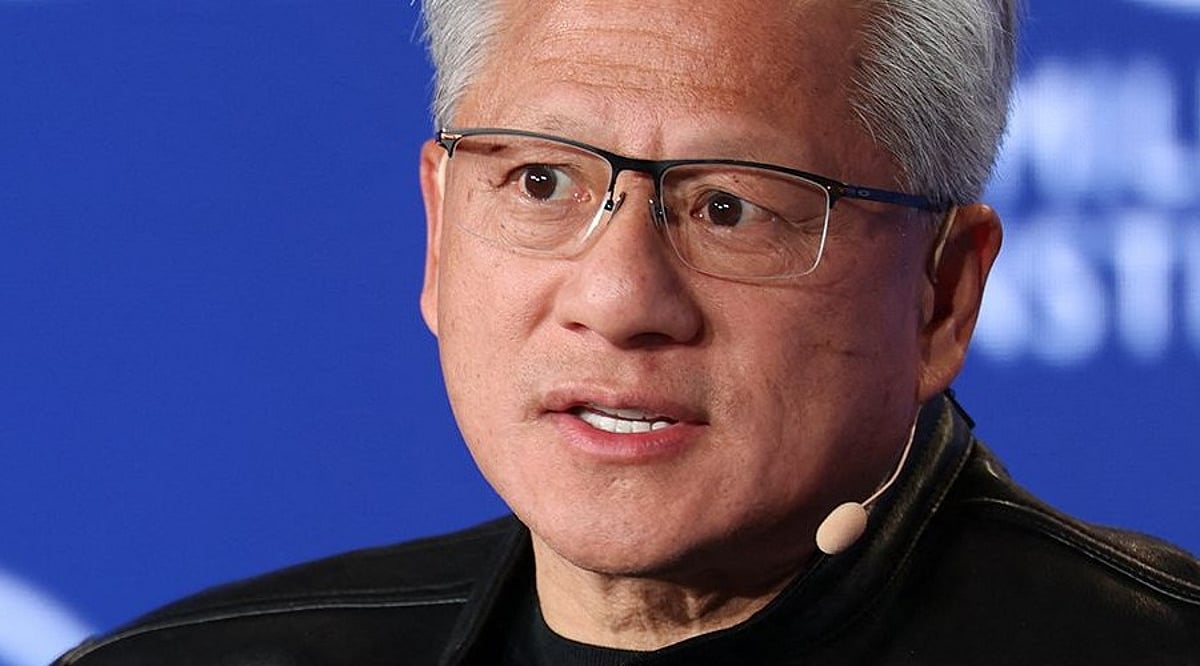
Jensen Huang, NVIDIA’s founder and CEO, saw early that the AI boom would depend not just on chatbots but on massive data centers packed with chips, memory, networks, and power systems. His strategy turned NVIDIA from a graphics chip company into a foundational supplier for the entire AI economy.
The GPU Became the Start of a Much Bigger System
Huang’s key bet was that a graphics processor could do far more than graphics. NVIDIA built CUDA, a software platform that lets developers use its GPUs for advanced computing. That choice gave the company a strong base when AI models began demanding huge amounts of compute.
For the quarter ended July 26, 2026, NVIDIA posted $96.2 billion in revenue, up 106% year-over-year. Data Center revenue reached $89.0 billion, up 117%. Net income hit $59.7 billion, with a gross margin of 75%. NVIDIA expects $108 billion in revenue for the next quarter and about 70% revenue growth for fiscal 2028, though supply limits still affect that outlook.
Vera Rubin Turns the Rack into One AI Computer
NVIDIA’s latest move takes the strategy further. The Vera Rubin platform combines Rubin GPUs, Vera CPUs, NVLink 6, ConnectX-9 network chips, BlueField-4 DPUs, Spectrum-6 systems, and Groq 3 LPX. Several racks can act as one large AI computer.
NVIDIA says Vera Rubin can deliver 10 times the agent throughput of the Grace Blackwell platform at scale. The platform is designed for AI agents that call tools, search data, write code, and take many steps before completing a task. Such workloads need fast chips, fast memory, and fast links between every part of the system.
A data center can no longer rely on raw GPU speed alone. Memory, storage, network systems, security, and power all affect the final cost of each AI response. NVIDIA now sells an architecture that connects these pieces.
Power, Capital and Cloud Capacity Join the Strategy
Huang has also moved closer to the physical side of AI infrastructure. NVIDIA now treats land, power, and data center space as key resources. In August, the company partnered with SB Energy to secure land, power, and shell capacity at the PORTS-Pike Technology Campus in Ohio. OpenAI will serve as the tenant.
Capital has become another part of the plan. NVIDIA announced partnerships with Apollo, BlackRock, Blackstone, Brookfield, Goldman Sachs, and KKR. These platforms aim to mobilize more than $500 billion in third-party capital for AI infrastructure over time. The capital does not count as NVIDIA revenue; the goal is to give AI companies and cloud providers access to large pools of long-term infrastructure money.
AWS and NVIDIA plan to deploy 2 million additional NVIDIA GPUs across AWS infrastructure in 2027–2028. The deal also covers Vera CPUs, network systems, open models, data tools, and robotics.
NVIDIA has also expanded its reach into software. On September 3, the company agreed to acquire Hugging Face for $12.93 billion. The deal would give NVIDIA a deeper role in the open AI software ecosystem and help expand access to models, tools, and AI infrastructure.
Huang’s Real Advantage is the Full Stack
The central idea behind Huang’s strategy is not a single GPU. It is control of the system around the GPU. NVIDIA supplies compute, software, network systems, and rack architecture. It now has a role in power access, infrastructure finance, and developer software as well.
That model helps explain why the company can grow as AI hardware becomes more complex. Every new AI workload creates demand across several layers at once.
The next test will come from agentic AI, where one request can trigger hundreds or thousands of steps. That workload can create far more demand for compute than a simple chatbot response. NVIDIA has built Vera Rubin around that shift.
Huang’s long bet has reached a new stage. NVIDIA no longer sells only the engine for AI. It sets the factory around it, from the first line of code to the data center floor.
Leave a Reply